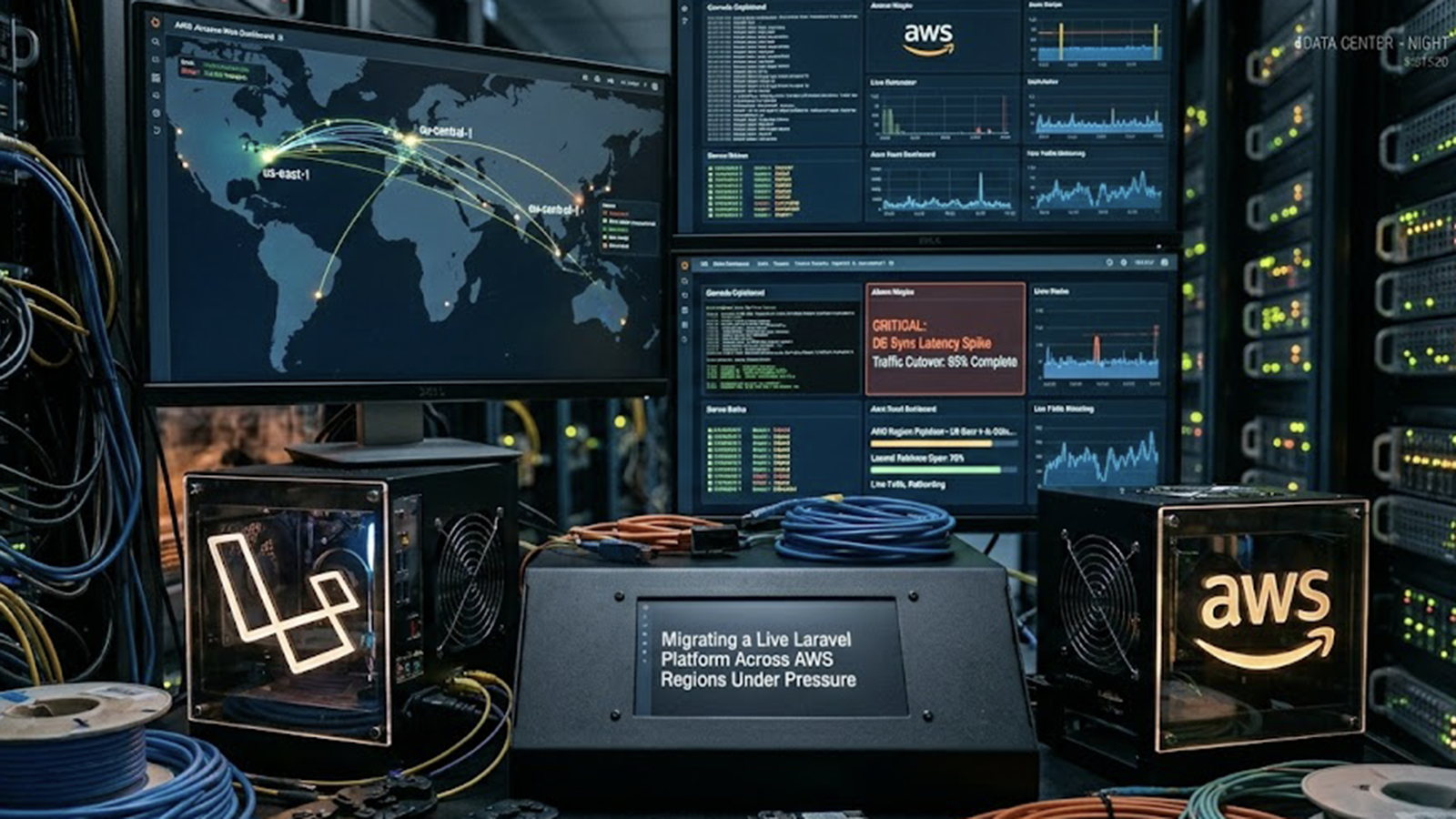
How we moved production infrastructure from Bahrain to London while protecting live workloads
Migrating a Laravel platform across AWS regions is already a serious technical task. Doing it while the existing region is unstable adds a completely different level of pressure.
During an AWS Bahrain disruption, we had to migrate production Laravel infrastructure into the London region while protecting live workloads. The platform supported operational workflows, user activity, database driven features, scheduled jobs, and customer facing services.
This was not a clean planned migration with unlimited preparation time. It was a recovery led migration, where the priority was to restore stability without creating new risks.
Understanding the Production Risk
Live Laravel platforms are rarely just one application server and one database. They often include queues, scheduled tasks, background workers, storage directories, API integrations, SSL certificates, DNS records, mail services, monitoring, and admin dashboards.
During the migration, each of these layers needed to be reviewed. If the web application comes online but queues are broken, users may still experience failures. If the database connects but file storage is missing, important workflows may fail. If DNS is updated before SSL and application validation, users may see errors even though the server is technically running.
The migration therefore had to be treated as a full platform recovery, not just an EC2 rebuild.
Why Laravel Helped the Migration
Laravel’s environment driven configuration made the migration safer. Database hosts, queue drivers, cache stores, mail settings, storage disks, and third party credentials could be updated without rewriting application code.
This is one of Laravel’s practical strengths in production environments. When configuration is properly separated from business logic, infrastructure changes become much easier to manage.
The application did not need major code rewrites to run in London. The priority was rebuilding the correct infrastructure, restoring the correct environment variables, and validating the application against the new services.
Rebuilding EC2 Application Servers
The first step was provisioning new EC2 instances in the London region. These needed to match the expected Laravel runtime environment, including PHP, Nginx, Composer dependencies, file permissions, cron jobs, Supervisor, and queue workers.
Application deployments were reviewed carefully to ensure the correct branch, environment file, storage permissions, and cache configuration were in place.
Once the server was ready, we tested application health locally before exposing traffic publicly. This helped separate server configuration issues from DNS or routing issues.
Moving the Database to RDS London
The database layer was the most important part of the migration. A Laravel application can only behave correctly if the database is consistent, reachable, and configured securely.
We restored the production database into Amazon RDS in London and updated the application environment to use the new endpoint. Security groups and database access rules were configured to allow the new application servers to connect securely.
After connection was established, we validated key application tables, recent records, authentication flows, and critical business operations.
Handling Queues, Schedules, and Background Workers
Laravel queue workers and scheduled commands are easy to overlook during emergency migrations. However, they are often responsible for important tasks such as email notifications, file processing, reporting, payment callbacks, and system maintenance.
We reviewed queue configuration, Supervisor processes, scheduled commands, and log files to ensure background processing was working correctly in the new region.
This step was essential because a platform can look healthy from the frontend while background tasks silently fail.
DNS and Cutover Planning
The final cutover involved DNS updates, SSL validation, and routing traffic to the London environment. DNS changes were handled carefully to avoid sending users to an environment that had not yet been fully validated.
After the DNS update, we monitored the application closely and tested important user journeys again. This included login, data loading, form submissions, admin workflows, and background job behaviour.
A production migration is only successful when users can complete their real workflows, not merely when a health check returns green.
What We Would Recommend for Similar Migrations
For teams planning similar migrations, preparation makes a major difference. Even if the migration is triggered by an incident, the recovery process is much smoother when the application already follows good deployment and configuration practices.
Our key recommendations are:
Conclusion
Migrating a live Laravel platform across AWS regions under pressure requires a balance of speed and discipline. Moving quickly matters, but uncontrolled changes can create more problems than the original outage.
By rebuilding the application layer in London, restoring the database into RDS, validating queues and background workers, and managing DNS cutover carefully, we were able to stabilise the platform and reduce future regional dependency.
The experience reinforced an important point: resilient Laravel infrastructure is not only about code quality. It is about deployment discipline, operational readiness, and infrastructure architecture that can survive real world disruption.