Every business knows the feeling. The phone rings while your team is with a customer. An online lead arrives at 8pm. Someone needs to move an appointment, asks the same question for the third time that day, or wants a callback that never quite makes it to the top of the list.
The result is not simply a busy reception desk. It is missed opportunities, slower responses, a poor customer experience and capable people spending too much of their day on repetitive work.
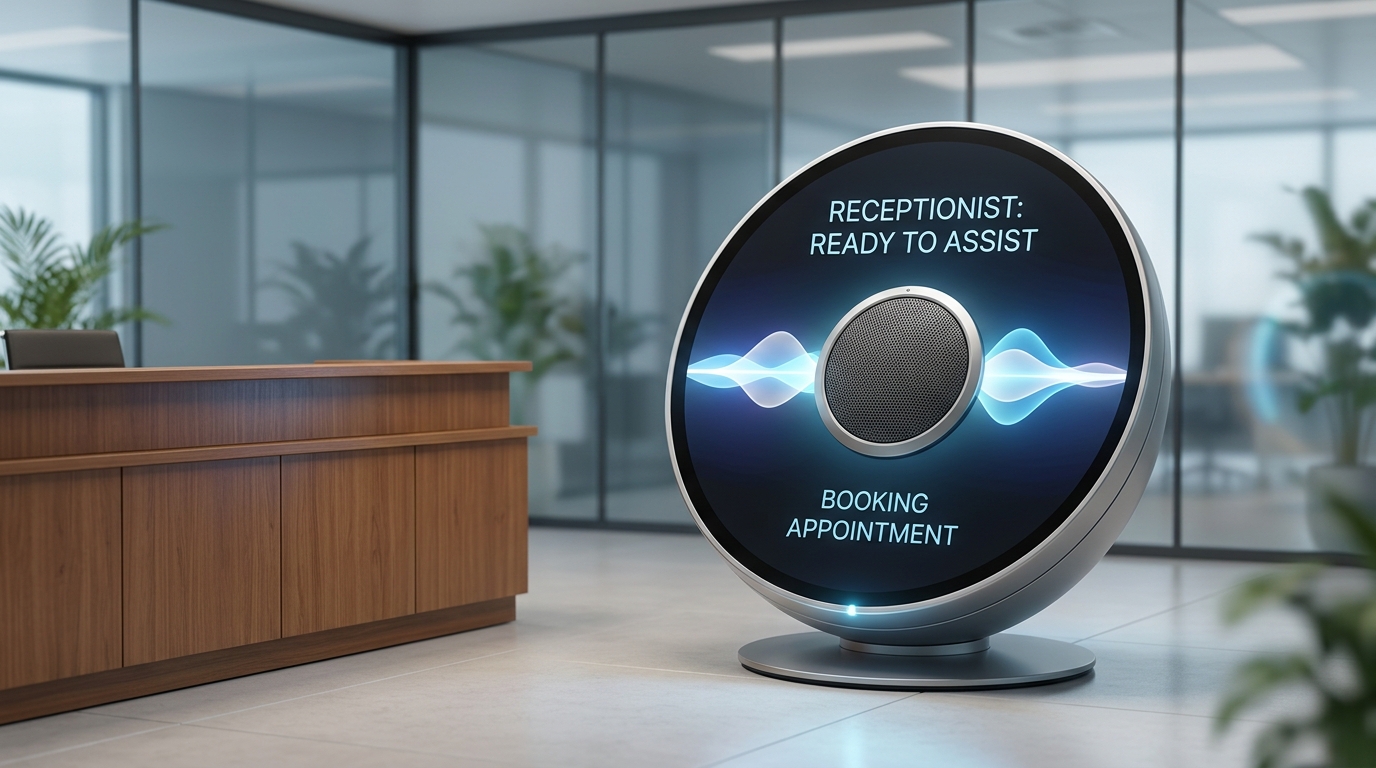
An AI voice agent can now answer a call naturally, understand why someone is calling, follow approved rules, check availability, book an appointment, take a message, send a confirmation and hand the conversation to a person when it needs human judgement.
Can it replace a receptionist or a calling team completely? Sometimes it can remove a large part of the routine workload. It should not replace the people who deal with complex decisions, sensitive matters, complaints or customers who genuinely need a person. The better question is: which calls should no longer need to wait for someone to become free?
That is where an AI receptionist can make a real difference.
"I have spent more than 15 years helping organisations use technology to solve real business problems. I am also a responsible AI advocate and a contributor on AI ethics, bias and transparency. My view is simple: AI should make a business more responsive and useful, not less human. People should stay in control of important decisions and customers should always know where to turn when they need a person."
By Rehan Ahmed, Co-Founder and CEO of Smart Web Agency
What is an AI voice agent?
An AI voice agent is software that can answer or make phone calls and hold a natural conversation within boundaries you set. Unlike a traditional phone menu, it can understand what the caller means rather than force them to press a number.
For example, an AI voice agent for business could:
- Answer inbound calls straight away, including outside normal hours.
- Ask why the caller is getting in touch and capture the right details.
- Answer approved questions about services, locations, opening times or next steps.
- Check a calendar and book, amend or cancel an appointment.
- Qualify a new enquiry before passing it to the sales or reception team.
- Call back leads that have asked for more information.
- Send a text or email confirmation after the call.
- Add a concise call summary and next action to your CRM.
- Transfer a call to a person whenever a defined rule is met.
The useful part is not the voice alone. It is the workflow behind it: phone system, approved knowledge, calendar, CRM, booking system and clear escalation rules working together.
The calls an AI receptionist can take off your team's desk
| Customer need | What the AI voice agent can do | When a person should take over |
|---|---|---|
| New enquiry | Capture details, ask approved qualifying questions and arrange the next step | The enquiry is complex, high value or outside the script |
| Appointment booking | Check live availability, offer slots and send confirmation | The appointment needs judgement, special approval or a non-standard arrangement |
| Common question | Give an approved answer about services, hours, location or pricing ranges | The answer is not in the approved knowledge base |
| Missed call or after-hours call | Take a message, create a callback task or book an available slot | The caller is distressed, urgent or asks specifically for a person |
| Lead follow-up | Call a warm lead, answer basic questions and arrange a consultation | There is a negotiation, objection or detailed sales discussion |
| Existing customer follow-up | Send reminders, recover missed appointments or arrange a callback | The call concerns a complaint, sensitive information or a disputed issue |
Beyond reception: turn enquiries into appointments and repeat business
The strongest use of an AI voice agent is often not a single call. It is the complete journey around it:
Marketing or website enquiry, then an AI conversation, qualification, appointment, confirmation, reminder, follow-up and retention.
For an appointment-led business, this can be separated into three practical roles:
- New enquiry agent: responds to a fresh lead, understands the service they need, checks availability and books the right next step.
- Reactivation agent: contacts suitable previous customers about a relevant screening, service, offer or follow-up, then helps them rebook where the campaign and permissions allow it.
- Workshop or event agent: answers questions about an event, checks eligibility and reserves a place or sends the right information.
Every outcome should be written back to one place, such as a CRM or booking system: booked, interested, needs a human follow-up, callback requested, no answer or do not contact. This gives the team a clear view of what happened and makes the next action consistent.
For a healthcare practice, the first use case might be a new patient enquiry. The agent can ask which service they are interested in, find the right practitioner, check appointment availability and book the consultation. An AI voice agent for healthcare should not diagnose, give treatment advice or handle a sensitive clinical conversation. Those are human responsibilities.
The same approach works for dental clinics, physiotherapy practices, aesthetic clinics, garages, estate agents, trades businesses, professional services firms and any organisation that loses valuable time or revenue when calls go unanswered.
Can an AI voice agent really replace a receptionist?
It can replace the repetitive part of reception work, but that is not the same thing as replacing a good receptionist.
A strong receptionist brings empathy, context, judgement and the ability to deal with unusual situations. AI is most effective when it becomes the always-available first line: it answers immediately, handles predictable requests and gives the human team a clean, well-recorded handover when needed.
Think of it as a trained virtual front desk that never gets tired of booking a standard appointment or confirming an opening time. Your people then spend more time helping customers who need a real conversation.
This is also why I would not start with an ambitious promise to automate every call. Start with one clear problem, prove it works and expand only when the experience is good for both callers and your team.
How to build an AI voice agent yourself in seven practical steps
You do not need to start with a huge technology project. A basic AI voice agent can be built using an AI voice platform, a business phone number, a well-written knowledge base and one or two integrations. The hard part is not opening an account. It is deciding exactly what the agent should and should not do.
1. Choose one call journey to improve
Do not begin with “answer every call”. Begin with one measurable problem, such as:
- Every missed inbound call should receive a helpful response.
- New leads should be contacted within a few minutes.
- Customers should be able to book a standard consultation without waiting for reception.
- No-shows should receive a polite rebooking option.
The smaller and clearer the first journey, the easier it is to test and improve.
2. Map the conversation before choosing technology
Write down what happens today. What questions does the team ask? What information is essential? Which calendar is the real source of availability? What counts as a successful outcome? When must the caller be transferred?
For each call type, define:
- The opening line.
- The information the agent can collect.
- The answers it is allowed to give.
- The answers it is allowed to give. The action it can take.
- The point at which it stops and brings in a person.
This is the practical knowledge that turns a clever demo into a useful AI receptionist.
3. Give the agent a clear, honest opening
Never make the caller guess whether they are speaking to a person. A simple opening works well:
“Hello, you have reached [Business Name]. I am [Agent Name], the virtual assistant. I can help with appointments, opening times and general enquiries. If you need a colleague, I will arrange that for you.”
This keeps the experience transparent and sets the right expectation.
4. Build an approved knowledge base
The agent needs a small, accurate source of truth. Start with services, locations, opening hours, frequently asked questions, rules, price guidance where appropriate and the exact wording for anything sensitive.
Do not load every document you own and expect the system to work it out. A concise, maintained knowledge base is safer and produces better answers.
5. Set firm boundaries and escalation rules
This is the most important step. Tell the agent what it must never do and when it must hand over.
Typical rules include:
- Do not invent information, prices, availability or policies.
- Do not give medical, legal, financial or other regulated advice.
- Do not disclose personal information before the right identity checks.
- Transfer complaints, emergencies, vulnerable callers and sensitive requests to a person.
- Take a message if the agent is unsure.
- Stop an outbound follow-up if the customer asks not to be contacted.
6. Connect the systems that matter
For a first version, connect the agent to the real source of appointment availability and the place where your team works. That may be a calendar, booking system, CRM, helpdesk, email or SMS platform.
Without these connections, the agent can still take messages. With them, it can complete work: book an appointment, create a lead, trigger a confirmation and leave the team with a useful summary.
7. Test, then run a controlled pilot
Test normal calls, unclear questions, interruptions, different accents, incorrect information, requests for a person and the cases the agent must refuse. Review the recordings or transcripts where appropriate, adjust the instructions and only then give it a limited live role.
Measure what changed: calls answered, response time, appointments booked, leads qualified, handovers, no-shows recovered and customer feedback. A pilot gives you evidence, not assumptions.
A simple AI voice agent prompt to start with
You do not need to expose a complicated technical prompt to get started. The core instruction should be clear enough for a new member of staff to follow:
You are the virtual assistant for [Business Name]. Help callers with [approved tasks]. Use only the approved knowledge and connected systems. Do not guess. If a caller asks for [restricted topics], is upset, needs urgent help, asks for a human or you are unsure, politely transfer the call or take a message for the team. At the end of every call, confirm the next step and record a concise summary.
The exact wording will change from business to business, but the principle remains the same: clear purpose, trusted information, limited actions and a safe route to a person.
Can I make an AI voice agent for free?
You can often prototype an AI voice agent using trial credits or low-cost tools. That can be enough to learn whether the conversation design works. A reliable business version will normally have ongoing costs for phone minutes, AI usage, integrations, monitoring and support.
The most expensive mistake is not choosing the wrong platform. It is launching a badly defined agent that books the wrong thing, gives an unapproved answer or creates work for the team to fix. Start small, test carefully and price the system around the value of the calls it saves or converts.
Do I need to know code, n8n or a specific platform?
No. Many platforms make it possible to create a basic AI voice agent without code. You may see these described as an AI voice agent builder. Tools such as workflow automation platforms can be helpful once you need the agent to create records, update a CRM or trigger a longer follow-up sequence, but they are not the starting point.
The essential elements are simpler:
- A phone number or call-routing setup.
- A voice agent with good instructions.
- Accurate business knowledge.
- A calendar, booking system or CRM connection where needed.
- Human escalation rules.
If these five elements are right, the technology becomes much easier to choose.
Responsible AI is not optional
I am optimistic about AI, but I do not believe in using it carelessly. A voice agent may hear names, phone numbers, appointment details and personal concerns. It must be designed with trust in mind.
At Smart Web Agency, our approach is built around fairness, transparency, accountability and human oversight. For a voice agent, that means:
- Tell callers when they are speaking with an AI assistant.
- Collect only the information needed for the task.
- Keep clear records of the actions the agent took.
- Give customers a route to a human without making them fight the system.
- Review performance regularly and correct weak or misleading responses.
- Apply stronger controls when calls involve health, financial information or other sensitive data.
- Build outbound campaigns only after checking the right consent, suppression and data-protection requirements.
For UK direct marketing, the rules are particularly important. The ICO explains that PECR restricts unsolicited marketing by phone, email and text, and that UK GDPR obligations apply when personal information is used. Marketing calls and automated calls can have different requirements. Read the ICO guidance on electronic and telephone marketing and get proper advice for your own campaign before going live.
This is not legal advice. It is a reminder that a responsible AI voice agent is not just a voice and a script. It is a business process with accountability behind it.
How Smart Web Agency can help
We are sharing this craft knowledge because more businesses should understand what is possible before they buy another piece of software or commit to a large project.
If you want to build the first version yourself, use the steps above. If you would like help, Smart Web Agency can work with you from the practical starting point: review your call journeys, identify the best first use case, design the conversation, connect the right systems, set safe escalation rules and measure the result. If you are looking for an AI voice agent agency, that is the standard we believe you should expect from any partner.
We have helped organisations adopt AI, automation and connected digital systems in ways that are useful, secure and maintainable. We do not recommend AI simply because it is fashionable. If a better phone process, clearer website journey or human callback process is the right answer, we will say so.
Frequently Asked Questions
An AI voice agent is a conversational system that answers or makes calls, understands spoken requests and completes defined tasks such as taking a message, qualifying a lead or booking an appointment.
Start with one narrow call journey, map the conversation, prepare approved knowledge, set handover rules, connect the relevant systems and run a controlled pilot. The quality of the workflow matters more than the number of features.
Yes. It can follow up a warm lead, remind customers about appointments, recover missed appointments or support a carefully designed reactivation campaign. Before using it for direct marketing, make sure your consent, opt-out and data-protection process is appropriate.
Yes, if it is connected to your calendar or booking system and you have defined the appointment types, availability rules and exceptions it can handle.
Look for a good fit with your actual call journeys, natural speech, reliable handover to people, secure integrations, transparent reporting and enough control to prevent the agent from giving unapproved answers. A flashy demo is not enough.
Pricing normally depends on call volume or minutes, the complexity of the integrations, the number of workflows, the knowledge base, monitoring and ongoing improvement. Ask for costs to be separated into setup, monthly platform support and usage so you can judge the real value.
Yes, but sell a clear outcome rather than a generic bot. For example, a missed-call recovery service for trades businesses or an appointment-booking assistant for clinics. Be transparent about what it does, what it cannot do, how data is handled and who supports it when a call needs a person.
The practical next step
Pick one call journey this week. Listen to ten recent calls or missed-call messages, identify the repeated questions and write down the exact point where a customer should be able to book, receive information or reach a person faster.
That is the beginning of a useful AI voice agent. Not a gimmick, not a replacement for every human conversation, but a reliable way to make sure the right calls are handled well.
If you would like us to assess whether an AI receptionist or voice-calling workflow is right for your business, contact Smart Web Agency. We can help you build it properly, test it responsibly and connect it to the systems your team already uses.